Showing posts with label cross-curricular connections. Show all posts

May 5, 2024

Enhancing Reading Comprehension with Cross-Curricular Scavenger Hunts

 Written by Emily Upton - Posted May 5, 2024

The worst thing about teaching science and social studies was the textbooks. They were a super boring, dated snoozefest that did not engage my students, so they immediately forgot what they read. Want an alternative to the dusty textbooks sitting on your shelf? You need scavenger hunts. Picture your students being fully engaged in a fun and interactive learning experience that not only bolsters their reading skills but also covers a range of subjects such as science and history. 

No more boring worksheets, textbooks, or repetitive exercises. These scavenger hunts will transform your teaching while helping your students actually retain what they're learning. They're a chance for your students to collaborate while working on finding details in a text. These aren't your typical task cards! Read on for tips on how to use scavenger hunts in your classroom.

What Are Reading Scavenger Hunts?

Reading scavenger hunts are a combination of task cards and escape rooms while mixing in reading comprehension. Get your students up and moving as they learn about science and social studies topics! Each scavenger hunt includes 10 mini reading passages about a topic. 

Students will read the 10 short comprehension passages as they hunt for the passage that matches 
the "code word clue" on each card. 
As they collect their answers, they record them on the special recording sheet. At the end of the scavenger hunt, they unscramble the letters to reveal the secret word.

They are super easy to set up. Simply print and cut out the passage cards, then hide them around your classroom. Students will love hunting for each card in the scavenger hunt path! And you'll love that they are practicing rereading and finding details in a text.

Benefits of Cross-Curricular Reading Scavenger Hunts

Beyond the obvious benefits of being more engaging for students and giving you an alternative to boring textbooks, there are lots of benefits to using scavenger hunts in your classroom!

  • Get Students Moving: Scavenger hunts give your students a chance to get up out of their seats and move around the room. It's important to give our students chances to stand up and walk around throughout the day, and these allow you to do that without losing instructional time.

  • Practice Citing Answers: Students are required to write down the number of the card where they found the answer to the "code word clue". This helps students practice citing where they found their information! This is a great time for students to also practice reading to identify specific details in the text. They are looking for the sentence that contains the code word clue each time.

  • Create a Challenge: Instead of task cards that follow a specific order, students have to hunt through the cards to find the correct answer. This means that they will be rereading the passages over and over! Rereading the content will help the information stick, and having to search for the answers instead of knowing what comes next will keep them engaged in the challenge.

How to Use Reading Scavenger Hunts

You can use reading scavenger hunts in a variety of ways. They are a great review before an assessment on a specific topic. You could also use them to frontload information about a new unit. 

Scavenger hunts make great sub activities because there's not a lot of prep! Simply print the cards and leave them for your students.

For me, cross-curricular connections are my jam. I love using scavenger hunts to practice reading skills during science and social studies! This lets my students practice reading while also learning content for a different subject area.

Examples of Cross-Curricular Reading Scavenger Hunts

Ready to dive in? Check out these examples of cross-curricular scavenger hunts! Each scavenger hunt includes 10 short passages about the given topic.


Apr 15, 2024

Exploring the History of Earth Day in Upper Elementary

 Written by Emily Upton - Posted March 16, 2024

Get ready to be the Miss Frizzle of history and hop into your time machine to teach your students about the history of Earth Day! Let's take a trip back in time to 1970, an incredible year that sparked widespread environmental awareness and gave birth to the amazing celebration we now know as Earth Day. It's not just a history lesson, though - it's a chance to inspire our young learners to become the protectors of our planet's future! As upper elementary teachers, we have an opportunity to ignite their curiosity and passion for environmental activism by exploring the origins of this global movement.

history of earth day in upper elementary with earth day themed lesson resources

Imagine a world where pollution is everywhere and people don't care about the environment. But there's a tiny bit of hope - Earth Day! It was created by ordinary people who wanted to make a difference. Now, it's a day when people all over the globe come together to protect our planet. As teachers, we can use Earth Day to teach our students about the environment and how we can help. Let's talk about how to make history come alive for our students as we teach them about the history of Earth Day.

Understanding the Origins of Earth Day

Earth Day started in 1970 when people began to notice the increasing pollution levels and that we weren't treating the Earth well. Gaylord Nelson, a US senator, came up with the idea of a national day to raise awareness about environmental issues. Millions of people took to the streets on April 22, 1970, in the first-ever Earth Day celebration. Since then, Earth Day has become a global annual event that reminds us of our responsibility to keep our planet healthy and happy. As teachers, we can inspire our students to be the change-makers of tomorrow. Let's celebrate Earth Day every April 22nd and give a high-five to Gaylord Nelson and all the people who made it happen.

Why Should You Teach the History of Earth Day?

Teaching the history of Earth Day isn't just about memorizing dates and facts—it's about planting seeds of environmental awareness and activism in our students. By understanding how Earth Day came to be, kids can see how regular people, just like them, made a big difference. It can inspire them to take action and be stewards of the planet.

When students learn about the grassroots movement behind Earth Day, it shows them that change is possible, even when things seem pretty bleak. They see how people come together to tackle big problems, and it gives them hope for the future. Plus, it gets them thinking about their own impact on the environment and how they can make a positive difference!

Integrating the history of Earth Day into the curriculum is a no-brainer. It's a chance to teach important lessons about environmentalism, activism, and the power of community. Plus, it fits right in with subjects like social studies, science, and even language arts. By weaving Earth Day into our lessons, we're giving students a deeper understanding of the world around them and empowering them to be changemakers. And hey, who knows? Maybe we'll inspire the next generation of environmental leaders along the way.

Activities for Teaching the History of Earth Day

If you want to teach about the history of Earth Day with low-prep, engaging resources, you've come to the right place. These activities will streamline your lesson prep while keeping your students engaged in rigorous practice activities.

History of Earth Day Videos

I love using quick videos to introduce my lessons. These are some of my favorite free resources for starting your history of Earth Day lessons:

🌎 I love using these PBS Kids Videos to introduce holidays! They're short and to the point, and give your students come background knowledge on how Earth Day came to be. I always used these as an intro before we did any holiday activities in class!

🌎 If you aren't using Mystery Science in your classroom, you are seriously missing out. These short videos are super engaging, and they have a million episodes on YouTube that you could use for Earth Day!

History of Earth Day TImeline and Passages

These short engaging passages and timeline activity will quickly teach your students everything they need to know about the history of Earth Day. With comprehension questions and a built-in mini-project, the digital and printable versions of this resource will give you options when assigning that fit the needs of your classroom.

Teachers said, "I used this to pre-teach our Earth Day activities. My students and I enjoyed it! Good layout and age-appropriate information in a quick and efficient way to learn the history of Earth Day."


History of Earth Day Escape Room


Looking for an activity that is more collaborative? This escape room covers the history of Earth Day, as well as information about recycling and Earth Day fun facts. Students answer comprehension questions and use code ciphers to crack the code in order to complete the final coloring activity!

Escape rooms get your students up and moving. Use as a center activity, in small groups, or as an early finisher activity!


No matter what activity you choose, incorporating a history of Earth Day lesson into your plans will help your students to understand more about this important holiday. Instead of just teaching your students why they should care for our planet, help them understand how ordinary people came together to create maor change to help our home.


Jan 10, 2024

Using History Fun Facts to Fuel Creative Writing

Written by Emily Upton - Posted January 3, 2024

If your students groan when you say "It's time for writing!", you are definitely in the right place. If your students dread writing and don't know how to get started, history can be your secret weapon! In this blog post, we're going to explore how you can use history to fuel creative writing in your classroom and get your kiddos engaged so they actually WANT to write. Quick writes are one of my favorite ways to sneak a little extra writing into my day without absolutely overwhelming my students. 

A colorful map and bright pink paper are shown. The text reads "using history facts to fuel creative writing".

Why Integrate History and Creative Writing?

Now, you might be wondering why history and creative writing make such a dynamic duo. History is chock-full of captivating stories, fascinating characters, and mind-blowing fun facts that you can use to get your students interested in writing. What better way to get your students' creative juices flowing than by diving into the past?

Here are some tips to help you get started!

  1. Choose an Intriguing Historical Event: Start by picking an exciting historical event. It could be anything from the Wright brothers' first flight to the signing of the Declaration of Independence or even a lesser-known event that piques your interest. The key is to choose something that's packed with potential for imaginative storytelling.
  2. Introduce Historical Context: Once you've got your event, take some time to provide a bit of historical context. Share details about the time period, the people involved, and the circumstances surrounding the event. This helps students immerse themselves in the historical backdrop and adds depth to their writing.
  3. Spark Creativity with Questions: Encourage your students to think like historians and storytellers. Ask them questions like:

    • What if they were there when it happened?
    • How would they describe the sights, sounds, and emotions of the moment?
    • What could be some unexpected twists or hidden stories behind the event?
    • What would their character in that time and place be like?

Let the Writing Begin

Now, it's time for the magic to happen. Let your students loose with their creative writing. They can write from the perspective of someone who witnessed the event, create fictional characters caught up in the historical drama, or even craft a time-travel adventure.

Don't forget to set aside time for sharing and celebrating your students' creative works. You can host a storytelling session, create a classroom museum displaying their stories, or even have a historical-themed party where they read their tales aloud.

Using This Day in History Writing Prompts

This day in history daily writing prompts for 3rd - 5th graders
We've got an awesome resource to supercharge your history-inspired creative writing lessons: "This Day in History" writing prompts. These daily prompts are like a treasure trove of historical events, waiting to inspire your students' imaginations. Packed with a variety of writing types from informational to persuasive, these daily fun facts and prompts are sure to get your kiddos hyped about writing.

These are great to use as warm-ups, writing centers, or as a weekly independent assignment. They only take 10-15 minutes to complete. The best part? They're digital AND printable to meet your students' needs!

Imagine your students crafting stories about:

  • The day the Great Wall of China was completed.
  • The moment the first telephone call was made.
  • The adventure of the first woman in space.

Sound intriguing? We thought so! These prompts are a fantastic way to infuse history into your creative writing lessons effortlessly.

You can click here to check out the year-long bundle!

So, whether you're delving into the mysteries of ancient Egypt or exploring the innovations of the Industrial Revolution, remember that history is a goldmine for sparking creativity in your students. Give it a try, and watch your classroom come alive with exciting stories from the past. Happy writing, and may your students' imaginations soar to new heights! 🚀

Explore More: Related Posts


Nov 14, 2023

5 Tips for Painless Research Projects: Integrating Writing and Research Skills in Science Class

Written by Emily Upton - Posted Nov. 14, 2023

Hey there, upper elementary teachers! Does the thought of having your students complete a research project make you cringe? The hours spent researching, organizing facts, and writing it all down...I've been there. Even though you KNOW doing some research would spice up your science curriculum and get your students excited about learning, it can feel extremely overwhelming to tackle a project in science class, especially if you're short on time. 

However, these projects ignite curiosity and help your future scientists develop critical thinking and problem-solving skills. So, let's talk about some ways to make completing research projects in science a little bit more manageable. In this easy-to-follow blog post, I'll walk you through some tips to make research projects as pain-free as possible for you and your students!

Want a FREE guide to help you plan your next research project? Grab it here!

A student in a blue sweater and white shirt writes in a notebook. There is a science beaker with light blue liquid in it sitting next to them. The text on the image reads "Painless Research Projects: Integrating Writing and Science"

Tip 1: Let Them Choose

The secret sauce to a killer research project? Let your students pick topics that get them excited and engaged in their learning! There's nothing worse than arguing with 25 groaning fourth graders who are bored and don't want to write. Avoid this by giving them a list of science-related themes or ideas that jive with your curriculum. Then, let them be their own bosses and choose the one that interests them the most When kids have a say in their learning, they're more motivated and eager to dive in.

A science project is shown on a green background. Students choose a natural disaster and explain how it changed an ecosystem. They show before and after images.


Tip 2: Share Research Links

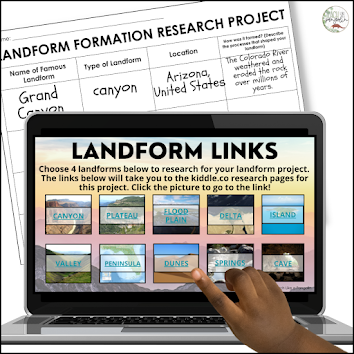
Finding the right info using the entirety of the Internet can be a maze for little researchers that feels impossible to navigate. They aren't sure what research terms to include, raise their hands a million times to say "I can't find the answer!", or end up on random unapproved sites (I'm looking at you, computer games). To keep things moving along and students on task, give them a list of research links. These can be websites, videos, articles, and books – you're still giving them a variety of resources to gather knowledge about their chosen topic. You're just narrowing it down a little bit. 😉 By providing these links, you help them get started on the right track without the headache of endless Google searches. 

A computer with images of landforms is shown with a student pointing to the screen. A piece of paper is in the background that reads "Landform Research Project" with information about the Grand Canyon.


Tip 3: Get Organized with Guides and Graphics

We all have that kiddo that gets off on the most random tangent when they're writing. They start off talking about ecosystems, and suddenly we've taken a hard left into a paragraph about their vacation to Cancun with Grandma. Make it simpler to keep your students on target and keep their thoughts organized with guided notes and graphic organizers. These tools help kids stay on course, outline their projects, and keep tabs on important details. If those graphic organizers are differentiated to meet the needs of different learners, that's even better! You can find pre-made templates or create your own to fit the project and grade level. It's like a GPS for their research journey.
A turkey project is shown with each feather a different color and representing different facts about turkeys (migration, adaptations, etc.) There are different graphic organizers at the bottom of the screen that are at varying levels, both with guided questions and blank.

Tip 4: Chunk it Up

Big projects can be intimidating. For a lot of kiddos in upper elementary, the thought of writing a research paper just seems like too much. That's where chunking comes in! Break the project into manageable pieces or milestones. It could be research, outlining, drafting, and presenting. Or, skip the "Big Research Paper" and have students create something else: a newspaper article, a poster, or a quick slideshow. By tackling one piece of the project at a time or helping students share their ideas in meaningful chunks, students won't feel overwhelmed, and they'll build confidence as they go.
A green composition notebook is shown with a newspaper project on top that talks about how zebra mussels are invasive species.


Tip 5: Rock Those Rubrics

To make grading super easy for you AND help your students see what they need to ace the assignment, create rubrics for assessment. These nifty tools break down your expectations into clear categories, so students know exactly how they can get the grade they achieve. I like to include a student checklist directly on the rubric so they can make sure their work is up to the standard I expect. Rubrics help you give constructive feedback too. You can focus on content, organization, presentation, and more. Share the rubric from the get-go so everyone's on the same page.

A cookie project is shown that compares and contrasts the physical and chemical changes in gingerbread and sugar cookies. There are crayons on the page, and a rubric that shows the expectations.


Skip to the Good Stuff: Project Examples

Introducing research projects into your upper elementary science class can be a total game-changer. But, it can also be super overwhelming for the teacher to plan alllll the things needed to make these research projects successful. Want to skip the planning stages? Check out these science projects that are ready to go with all of the tips shared above. They're like your one-way ticket to science engagement, without taking up your entire planning time.


CLICK HERE TO GRAB THE FREE GUIDE TO PLANNING RESEARCH PROJECTS!


Nov 6, 2023

Making Math Meaningful: Fostering Cross-Curricular Connections in Math Class

Written by Emily Upton - Posted Nov. 6, 2023

Math class often feels like it's in a world of its own, right? Different from reading and science or social studies, those natural connections between subjects that make learning stick for your students can be harder to come by. But math can be way more interesting and actually seem relevant to your students when it's connected to the real world! You can use cross-curricular connections to develop flexible thinking, master math vocab, and create a growth mindset. In this blog post, we're going to chat about why blending math with real-life stuff is a game-changer for students and teachers alike.

A pink background with a calculator and math notebook. The text reads "making math meaningful with cross-curricular connections".

Why It's Worth Your Time To Fit In Cross-Curricular Connections

Staying Interested and Engaged:  Have your students ever asked you "When am I ever going to use this in real life?" When students see math in action in their everyday world, math suddenly gets a lot more interesting, and they feel way more engaged in learning. They see how math actually connects to their lives! This can also help to build flexible thinking as students reflect on how they could use a math topic in real life.

Everything's Connected: Life's a lot like a giant puzzle, and math is a piece of that puzzle. When we mix math with other subjects, like science or art, your students see how all the pieces fit together. Your students start to understand how to solve problems in the real world, not just math problems on a worksheet. That flexible thinking allows your students to adapt their math skills to different situations.

Becoming a Problem-Solving Pro: Real-life math isn't always about following rules. It's about using your brain to come up with creative solutions. Giving students the opportunity to share and reflect on many different ways to solve the same problem helps them see math in a new light. When they work on these kinds of problems, your students become problem-solving ninjas, ready for anything.

Skills That Last a Lifetime: We use math in our daily lives, whether budgeting, cooking, or figuring out which phone plan is the best deal. When your students see how math connects to these everyday situations and they develop a growth mindset, they learn skills that they can use forever.

Boosting Brainpower: Real-world math and cross-curricular learning make your students think deeper. They're not just memorizing algorithms; they're thinking critically, putting pieces together, and leveling up their brainpower. A growth mindset pushes them to embrace challenges and keep growing.

How to Bring Cross-Curricular, Flexible Thinking, Math Vocabulary, and Growth Mindset to Life

Alright, now that we know why cross-curricular connections matter, let's talk about how you can make them happen in your class:

  • Teamwork Makes the Dream Work: Does your teacher bestie teach a different subject than you? Work together to plan a cross-curricular unit! When your students see the connections in what they're learning in their different classes, they get a deeper understanding of the content.
  • Get Real: Use real-life situations, like making a budget or cooking a meal, to show how math is super useful in everyday life. Developing flexible thinking helps students adapt math to these real-life situations.
  • Guest Star Power: Invite pros from different fields to come in and talk about how they use math in their jobs. It's like getting backstage passes to the real world and nurturing connections to the real world.
  • Adventure Time: Go on field trips to places where math is at work, like science centers or banks. Field trips are a great way to get students engaged!
  • Student Projects Rule: Let your students choose their own cross-curricular projects. It's like giving them the keys to the math kingdom and the chance to develop their flexible thinking, master math vocabulary, and embrace a growth mindset.

The Easiest Way to Foster Cross-Curricular and Real-World Connections

A notebook with a cross-curricular math journal is shown on a pink background with office supplies.
Looking for an easy way to make math more engaging for your upper elementary students? These journal prompts are here to help. They seamlessly blend math concepts with real-world connections, including history, science data, and reading. Your students will actively write about math while making those crucial cross-curricular links. Whether you prefer using the printable journal for individual warm-ups or the projectable Google Slides presentation to spark lively discussions, this resource offers a fantastic opportunity to enrich your math block with interactive learning experiences.

Each week follows the same format:

  • Mindset Monday: Students share their thinking about SEL-related math topics
  • Talking Data Tuesday: Interpret and discuss data in the context of the math focus of the week
  • Vocab Wizard Wednesday: Unpack misconceptions and take a deep dive into math content-specific vocabulary
  • Flexible Thinking Thursday: Share as many different ways to solve a given problem as possible
  • Historical Fact Friday: Foster real-world connections with a weekly fun fact and prompt that requires reflection on how math is used in the real world
With each week focusing on a different skill that aligns with upper elementary math standards, this journal makes fostering connections a breeze. 


Mixing math with the real world, flexible thinking, mastering math vocabulary, and developing a growth mindset is like adding a dash of excitement and endless possibilities to your learning experience. It shows your students how math isn't just some abstract thing they do in class; it's all around us! They'll see that math is more than just numbers; it's their passport to understanding the world around them while developing essential skills for life.


Oct 2, 2023

Why Daily Quick Writes Are a Must-Try in Upper Elementary

Written by Emily Upton - Posted Oct. 2, 2023

Let's chat about a simple yet incredibly effective tool for nurturing young writers in upper elementary classrooms: daily quick writes. These short daily writing exercises might just be the key to unlocking your students' creativity, boosting their confidence, and improving their overall writing skills. 

using quick writes with students in grades 3-5

Enhancing Writing & Thinking Skills

Picture this: your students writing something every. single. day. 

It might be a short story, a paragraph related to how they're feeling that day, or a creative response to a thought-provoking prompt. What's the result? Improved writing skills. 

With daily writing, students naturally encounter new words and phrases. They develop improved language skills, practice spelling and writing conventions, and learn how to share their ideas with others.

Quick writes aren't just about writing; they're about thinking too. Some prompts require students to reflect on their experiences, analyze situations, or make decisions. This fosters critical thinking skills. Students can then use those skills to tackle a variety of different writing types.

Like any skill, practice makes perfect. When students write every day, they naturally become more comfortable with getting their ideas down on paper, using proper grammar and sentence structure, and overall just feeling better as a writer. 

The more they write, the better they get. It's as simple as that.

Encouraging Creative Expression

Quick writes give students opportunities to write in a shorter format than most formal classroom writing assignments. They also provide students with the chance to let their imaginations run wild. Prompts like "Imagine you're an astronaut exploring a new planet" or "Write about the adventures of a talking animal" can inspire some seriously imaginative tales. Plus, it's a fun way to sneak in some creative writing while keeping students engaged!

You can even use quick writes to foster cross-curricular connections. For that kiddo who hates writing but loves science, this can be a way to help them practice their writing skills while giving them an outlet to discuss something they love!

Boosting Confidence

Remember the feeling of finishing a writing piece and thinking, "Wow, I did that!"? Well, that's exactly what daily quick writes can do for your students. As they see themselves improving day by day, their confidence in their writing abilities skyrockets. This newfound confidence isn't just beneficial for writing; it spills over into other subjects and aspects of their lives.

For reluctant writers, a daily quick write where the expectation is a paragraph is a lot less intimidating than writing a book report or completing a research project. You can help your struggling students feel more confident by giving them the chance to feel the success of completing their daily writing prompts.

Fostering a Love for Writing

The ultimate goal is to instill a lifelong love for writing. When students enjoy their daily quick writes, they're more likely to see writing as a joyous form of self-expression rather than something their teacher makes them do. 

Giving students choices, relating the writing prompt to a fun fact, or giving students the chance to illustrate their stories can help students get excited about writing.

Let your enthusiasm for writing shine through when you model writing for your students. Your students will pick up on your passion!

Fitting Quick Writes Into Your Day

We all know that there's never enough time during your language arts block to fit in all the things. Here are some ideas to fit quick writes into your schedule.

  • Use them as a daily center rotation
  • Have students complete them as bell work when they enter the classroom
  • Offer them as an early finisher activity
  • Sneak them into another subject, like social studies or science, if they're cross-curricular topics
  • Assign quick writes as homework
Ready to implement quick writes? Here are my top 3 tips:

  1. Set aside a dedicated time for quick writes, like the start or end of the day.
  2. Keep it fun and stress-free; encourage creativity over perfection.
  3. Give students the chance to share their writing in small groups, with the class, or using a digital platform like Flipgrid.

My Favorite Resource for Quick Writes

This Day in History Writing Prompts for upper elementary students
Need some quick write prompts to get started? Don't want to waste your precious planning time trying to hunt down writing prompts for the week?

Using This Day in History Daily Quick Writes can be an absolute game changer in your classroom. These ready-to-use monthly resources make a huge impact on student writing success with no prep from you. 

Each month offers different prompts related to a fun fact, and gives students the chance to build stamina while writing about a variety of topics. And, they're digital AND printable!

Teachers Love Them:

⭐ "What an excellent and super fun way to make writing fun and engaging for students! They love learning a new, daily factoid about why that particular day is special in the history of time."

⭐ "This resource has been a game-changer for my bell-work time! Students are really interested in finding out what the topic of the day is."

⭐ "I use these during centers and the students love finding out the fun fact of the day. Also, it incorporates the different types of writing well: persuasive, narrative, and expository."

Want your entire year of quick writes planned with no prep for you? Click here!

Daily quick writes are like little bursts of creativity and skill-building that can make a big difference in your upper elementary classroom. They enhance writing skills, encourage creativity, increase writing stamina, and most importantly can foster a love for writing that can last a lifetime.

If you're excited to implement daily quick writes in your classroom or have experiences to share, drop a comment below! 

Happy writing! 📝✨


© Teach Like a Pangolin 2023-2024
.